


Allocation of Investments by Age: A 2026 Guide
You're probably staring at two account statements and asking the same uncomfortable question a lot of near-retirees ask: am I too aggressive, or too conservative? One spouse wants to keep growing the nest egg. The other wants less market drama before retirement starts. Both are right to worry, because the answer changes as the years to use the money get shorter.
That's why allocation of investments by age became the default conversation starter. Age is a shortcut for time horizon, recovery time, and how much damage a bad market year can do before withdrawals begin. But age alone is not the answer. It's the first input, then you adjust for income sources, account type, spending needs, and how much drawdown risk your household can tolerate.
Why Age Has Always Been the Starting Point for Allocation
A couple in their late fifties sits at the kitchen table with two 401(k) statements, a legal pad, and no patience for vague advice. One statement is heavy on stocks. The other is more cautious. They want a straight answer because retirement is close, and neither of them wants to be the one who took too much risk.
That is why age became the anchor. Younger investors usually have more time to recover from volatility, while older investors have less room for error. Real retirement-plan behavior reflects that pattern. Vanguard's 2025 report on 2024 plan-year data found participant-weighted equity allocations of 87% for workers under 25, 88% for ages 25 to 39, then 84% at 40 to 44, 73% at 50 to 54, 60% at 60 to 64, 52% at 65 to 69, and 45% for ages 70 and older (Vanguard age-based allocation data). Equity exposure falls as retirement gets closer, and the hardest de-risking starts after mid-career.
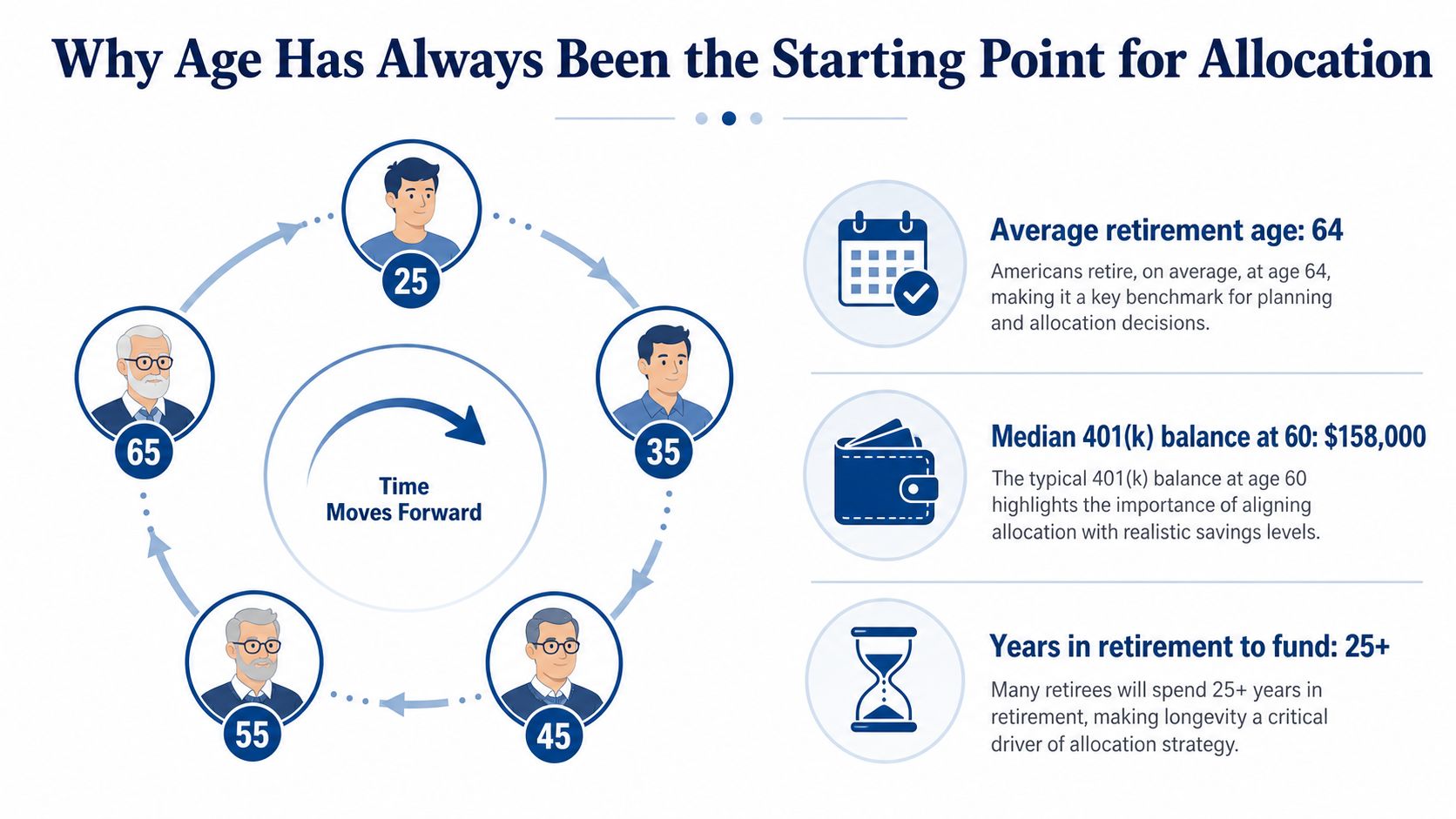
Age sets the starting line, but the finish line depends on the household
Older households do not automatically need to flee stocks. The portfolio's job changes. In your thirties, it is mainly trying to compound. In your sixties, it has to support spending without breaking the plan. That shift matters even more when the account is expected to fund retirement income instead of just grow on paper.
Practical rule: use age to draft the first allocation, then ask what the money has to do in real life.
That is the right filter for the rest of the decision. Age gives you a useful starting point, but it does not tell you enough. A strong balance sheet, guaranteed income, and years of work ahead can justify more equity risk. A weak income buffer and a near-term withdrawal need can justify less. The account type matters too. Money sitting in a taxable account, a traditional retirement account, or a Roth account can support different withdrawal choices, and those choices affect how much risk you can afford to keep.
The academic evidence points in the same direction. In a Columbia University working paper by Ameriks and Zeldes, the authors found that each additional year of age reduced stock allocation by about 93 basis points (Columbia working paper). That lines up with the long-used practitioner habit of trimming equity exposure by roughly one point per year of age.
For pre-retirees and retirees, the key question is simple. Can the portfolio keep funding spending if markets disappoint early in retirement? If the answer is no, age alone is too crude. Use it as the starting line, then adjust for income sources, account type, and drawdown risk. One useful reference point is this asset allocation guide, but the final mix has to fit the household, not the calendar.
The Core Mechanics of Age-Based Allocation
A portfolio is not one thing. It has separate jobs. Equities are there to grow purchasing power. Fixed income helps steady the ride and can also produce income. Cash equivalents give you flexibility when money is needed soon, and they keep you from being forced to sell at the wrong time.
That matters because the right mix is driven by what the money has to do. A household still in the accumulation phase can tolerate more market movement if the paycheck keeps coming. A household that is living off the portfolio has a different problem, because the portfolio now has to support spending as well as growth. In that setting, the allocation has to protect cash flow, not just chase return.
The logic is simple. Younger investors usually have a longer horizon, more time to recover from setbacks, and less near-term withdrawal pressure. Older investors often face the opposite, especially once retirement spending starts drawing money out of the account. That is where sequence risk becomes a real threat. A weak market early in retirement does more damage because withdrawals lock in losses and shrink the base that needs to recover.
The portfolio also has to match the account it lives in. Taxable accounts, traditional retirement accounts, and Roth accounts do not behave the same way when money is coming out. That changes which assets you want where, and it changes how much risk the household can reasonably keep. Age gives you a starting point, but income sources, account type, and drawdown risk decide whether that starting point is too aggressive or too cautious.
When the account is still being funded, volatility is annoying. When the account is funding spending, volatility becomes a cash-flow problem.
That is the rule I use. If the money will sit untouched for years, a higher equity share can make sense. If the money has to produce income soon, the portfolio needs more ballast and more liquidity. For a practical starting framework, use this asset allocation guidance, then adjust it for the household in front of you.
Classic Age Rules and Where Each One Breaks Down
Many investors have heard some version of 110 minus age, 100 minus age, or the old 60/40 split. Those rules are useful because they force a decision. They're also incomplete because they ignore the rest of the household balance sheet.
For a 55-year-old, the math looks like this:
- 110 minus age suggests about 55% stocks and 45% bonds and cash.
- 100 minus age suggests about 45% stocks and 55% bonds and cash.
- 60/40 suggests 60% stocks and 40% bonds, regardless of age.
What each rule gets wrong
The 110 rule can still leave a 65-year-old too exposed if retirement is already here and withdrawals are about to begin. It may be fine for a worker who still has years of stable income. It's much less comfortable for someone who's about to depend on that portfolio for living expenses.
The 100 rule can be too cautious for younger savers. A 30-year-old who's still accumulating and can tolerate volatility may give up too much long-term growth by following it mechanically.
The 60/40 split is the bluntest of the three. It ignores whether the household has a pension, Social Security coming soon, concentrated home equity, or a long runway before money is needed. It can work as a conversation tool. It fails as a personalized plan.
| Age | 110 Minus Age | 100 Minus Age | 60/40 Split |
|---|---|---|---|
| 55 | 55% stocks | 45% stocks | 60% stocks |
| 65 | 45% stocks | 35% stocks | 60% stocks |
The right takeaway is simple. Use these rules to start the discussion, then break them if the household's actual situation calls for it. That isn't sophistication for its own sake. It's just honest planning.
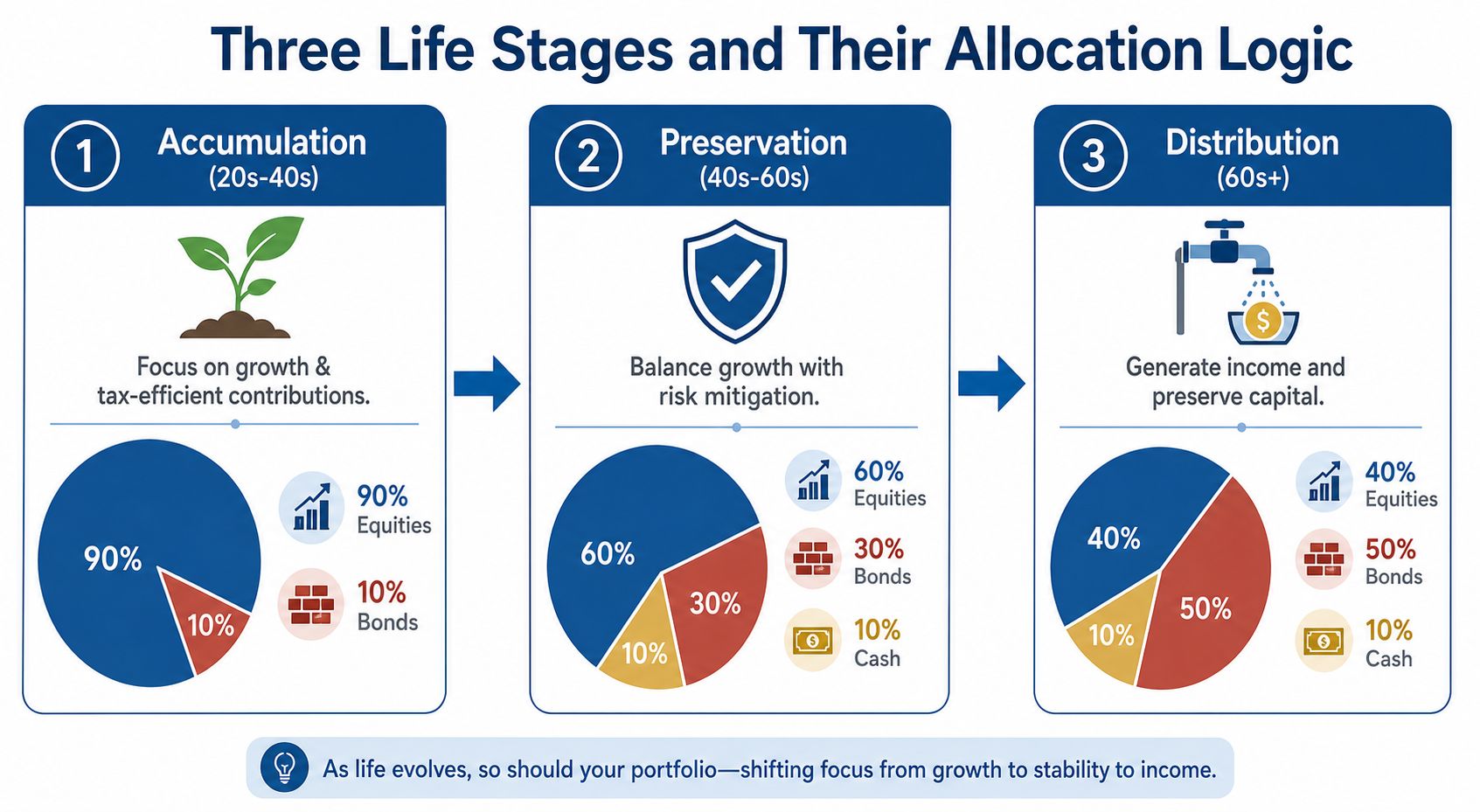
Three Life Stages and Their Allocation Logic
Age works better when you think in stages instead of birthdays. The same stock allocation can be sensible in one stage and reckless in another. The job of the portfolio changes as the household moves from earning, to protecting, to spending.
Accumulation means growth first
In the accumulation years, the main goal is simple. Keep contributing, keep costs down, and let time do the heavy lifting. Equity exposure usually stays high because the portfolio has years to recover from setbacks and because the dollar amounts are still building.
That doesn't mean every dollar belongs in stocks. It means the portfolio's center of gravity should favor growth assets, because a cautious portfolio can fall behind before the balance sheet has a chance to matter.
Pre-retirement means transition, not panic
The pre-retirement years are where people make the most mistakes. They get close enough to retirement to feel nervous, but they still need growth to keep up with spending and inflation. That's when the glide down should begin.
This is also when investors should start paying attention to where risk sits. A household can keep more growth inside the accounts that have the longest runway and more stability in the accounts that may fund early spending needs.
Retirement means income and durability
Once retirement starts, the portfolio is no longer just a growth machine. It has to produce cash flow and preserve purchasing power. A retiree who sells into a bad market year is not “patient.” They're creating a permanent setback.
That's why the retirement portfolio usually needs a larger stable-income sleeve and enough liquidity to avoid forced selling. The best allocation is the one that can survive withdrawals without panic.
How Glidepaths and Target-Date Funds Work
Target-date funds are built around a glidepath, a planned shift from more stocks to more bonds over time. The logic is sound. As retirement gets closer, the portfolio should become less exposed to a sharp market drop and better prepared to support withdrawals.
The direction is useful. The assumption that one glidepath fits every household is the weak point.
The academic wrinkle
MIT Sloan's modeling result points to a hump-shaped stock allocation over the working life. It pegs the optimal stock share around age 45 at 80% stocks, then shows it declining to a stable 60% in retirement (MIT Sloan model). That matters because it argues against a purely straight-line decline. Equity weight can peak in mid-career, then settle at a meaningful level even after work ends.
That is a more realistic view than the old habit of assuming older always means much lower stock exposure. It reflects two realities at once, labor-income stability and the rising importance of sequence risk as retirement approaches.
What this means for you
If you are evaluating a target-date fund, look past the date on the label. Check where the fund lands at retirement and how much equity it still holds afterward. A glidepath that keeps some stock exposure can make sense, especially if you have pension income, delayed Social Security, or cash reserves outside the portfolio.
A target-date fund gives a clean starting point for someone who wants simplicity, and it still needs to fit the rest of the balance sheet. A household that depends on the portfolio for spending needs a different answer from one with outside income covering a large share of retirement cash flow. That is the line that matters.
The Variables That Override Age Alone
Age gets too much credit when people ignore the income already sitting outside the portfolio. That is the first thing I look at. A stable pension, Social Security timing, and other guaranteed income can change how much risk the portfolio needs to carry.
The more useful question focuses on income coverage, how much of your retirement spending is already secured before the portfolio has to generate income.
The factors that matter more than the calendar
- Guaranteed income. A pension or Social Security reduces how much income the portfolio must produce.
- Risk tolerance. Not the answer on a questionnaire, but the amount of market decline you can live through.
- Time horizon. Money needed in the next few years should not be treated like money set aside for a decade out.
- Liquidity needs. Emergency reserves reduce the need to keep stocks ready for a near-term sale.
- Tax situation. Account type and tax treatment affect where different assets belong.
A teacher with a defined-benefit pension and a 403(b) can often afford a different mix than a same-age consultant whose brokerage account is doing all the heavy lifting. That is not a small detail. It changes the whole allocation decision.
A portfolio should be built around the withdrawals it must support, not around a neat chart that ignores the rest of the household.
The five years before and after retirement deserve special attention. That is when sequence risk can do real damage, because withdrawals start turning paper losses into permanent losses. If there is a pension, cash reserve, or delayed claiming strategy to lean on, the portfolio can usually carry a different shape than age charts suggest.
A Sample Household Allocation Across Accounts
A household with one spouse age 58 who has a pension, the other age 60 who has a 401(k) and an IRA, plus a taxable brokerage account, should not be treated as one flat age bucket. Social Security starts at 67, so the key question is how much of their spending is already covered before the portfolio has to step in.
Age alone would push you toward one generic mix across every account. That is too crude for a household that is already close to retirement.
Why each account should have a job
The pension changes the math first. It covers part of the retirement income floor, so the portfolio does not have to carry the entire burden. That often lets the 401(k) and IRA hold a more balanced mix than they otherwise would, because the household has a cushion outside market returns.
The taxable account needs a different role. It can serve as a spending buffer, which reduces the pressure to sell equities after a market drop. If cash reserves already sit outside the portfolio, that gives the household even more room to avoid forced sales at the wrong time.
Account type matters too. Traditional accounts and Roth accounts do not belong in the same box if tax efficiency is part of the plan. A household can use that flexibility to keep the overall mix sensible while still paying attention to future withdrawals and tax brackets.
Here is the right mindset:
- 401(k) or traditional IRA. Coordinate for the long run, not just this year.
- Taxable brokerage. Keep enough liquidity to avoid panic selling.
- Roth account. Treat it as a flexible reserve with a long horizon.
- Pension income. Count it as part of the total allocation picture, because it changes the need for portfolio income.
A household like this does not need one magic number. It needs an integrated plan that fits how the money will be used. A fiduciary conversation matters because the answer by account is often better than the headline answer.
For some households, a retirement planner like Coast Wealth Management can help coordinate that mix across pensions, workplace plans, and withdrawal timing without forcing every account into the same model.
Rebalancing, Withdrawal Order, and What to Do Next
Good allocation isn't a one-time decision. Markets move, life changes, and your mix drifts. If you never rebalance, the portfolio slowly stops matching the risk you thought you had.
A clean approach is to rebalance on a schedule or when the mix drifts far enough to matter. Then write down the withdrawal order before you need it. That keeps a bad market year from turning into a bad decision.
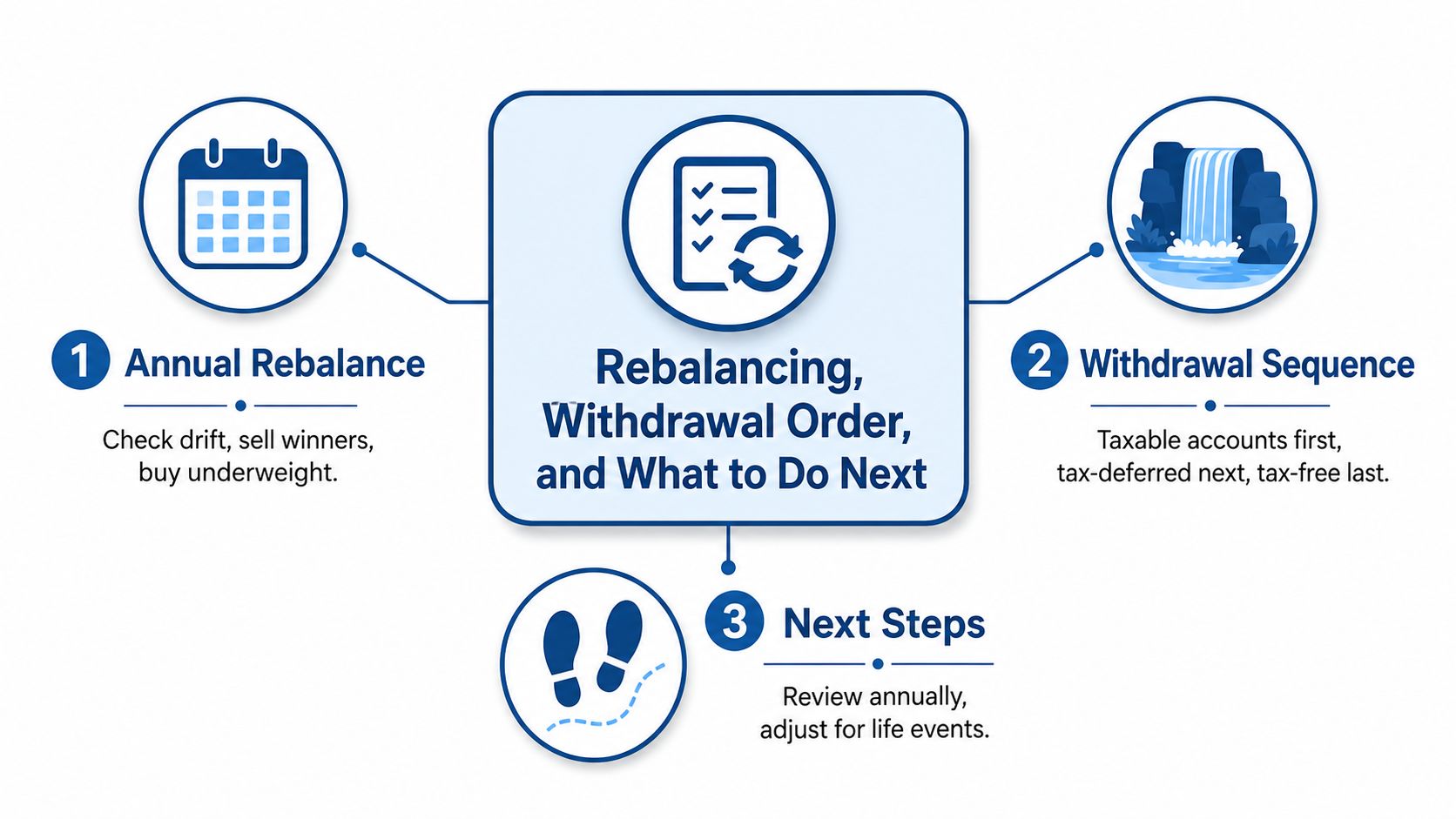
Do this next: map your income floor, list every account, and decide which dollars are for the next five years versus the next fifteen.
The next steps are practical, not glamorous. Review the mix annually. Update it after a job change, pension decision, inheritance, divorce, or health event. Make sure the withdrawal sequence matches your tax picture and your spending needs.
If you want a portfolio that fits real retirement life, not a textbook age chart, Coast Wealth Management can help you build that plan around income, taxes, and withdrawal timing. Visit Coast Wealth Management to start a conversation about aligning your investments with the years ahead.